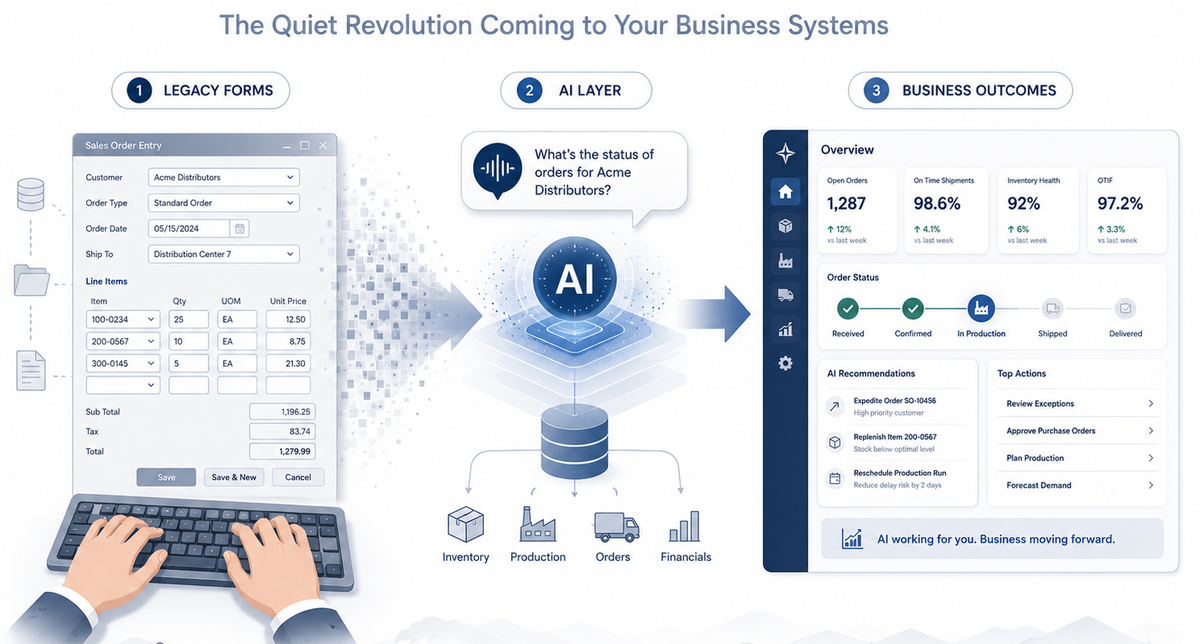
AI Over Form Over Data: The Quiet Revolution Coming to Your ERP

Erik Cornet, Pelorus Technology • July 30, 2026

Build Better ERP


Every week I talk with manufacturing and distribution leaders who are somewhere on the same journey. They have been experimenting with AI, sometimes for more than a year, and they have real results to show for it. Yet almost all of them describe the same quiet frustration. They feel scattered. A recent conversation with an executive of a midsized tool manufacturer captured it perfectly. He told me, with refreshing honesty, that his company was “a little bit of everywhere right now,” and that what he wanted most was to “consolidate and unify what we’re using.” That single sentence describes where most of the market sits today, and it points directly at what the next era of ERP is going to look like.

The real problem is not adoption, it is strategy


This leader was not an AI skeptic. Far from it. He was already using ChatGPT for quick work, Claude for large data projects such as rebuilding a pricing sheet, a Gemini powered chatbot on the company website, and Power Automate workflows wired through custom APIs into the ERP. In other words, the adoption question was already answered. The problem he was wrestling with was different, and it is the problem almost no vendor talks about honestly. It is strategy. When you are learning a dozen tools at once, each one fractionally, you end up with a collection of disconnected experiments rather than a coherent plan. The value is real, but it is trapped in silos, and nobody can see the whole picture. This is surprisingly similar to what we saw in the ERP industry years ago when we brought together siloed systems under one solution roof.


I hear a version of this in nearly every discovery call. The question has quietly shifted. Leaders are no longer asking whether AI can help them, because they already know it can. They are asking how they can stop chasing shiny objects and build something that fits together. That is a far healthier question, and answering it well is the heart of building a better ERP.

Business dashboard concept showing AI automating a quiet revolution from paper forms to a digital interface


Know where an idea belongs before you build it


One of the most useful things we do early in any engagement is give people a simple map of the AI landscape. We describe four tiers, and once a leader can see them, the fog usually lifts.


The first tier is machine learning, which is pattern recognition across large data sets. This is the tier that fits a factory floor perfectly. Sensors on a machine throw off vibration readings, spindle speeds, and tool performance data, and a model learns to predict what will happen next and where to make adjustments. The manufacturer I spoke with was already collecting exactly this kind of data through a machine monitoring partner, and he understood instinctively that no human could process it by hand.


The second tier is the one most people picture when they hear the word AI. It is the assistant, the chat interface, the model you hand a single task and thank afterward. Everyone uses this tier now, and it is genuinely helpful, but on its own it does not transform a business.


The third tier is where things get interesting for operations. These are agents that act with some autonomy. We describe an agent as a bright new graduate, extremely capable but without context. You have to sit it down, teach it the task, and tell it to raise its hand when it hits a problem. The fourth tier connects those agents into workflows, where one agent completes a step and hands it to another that checks the work, sends it forward, or calls a human for help.


The point of the map is not the labels. The point is that every AI idea belongs somewhere on it, and knowing where an idea belongs tells you what it will cost, what it will return, and whether it is worth doing at all. 

AI over form over data


For my entire career, enterprise software has followed one pattern. It was form over data. You open a screen, you type into fields, you press enter, business rules fire, and the data lands in the database. The form was the gatekeeper. It was how humans and data met.


That middle layer is now dissolving. We are moving to AI over form over data, and the form is the piece that goes away. The leader I spoke with saw this coming without any prompting from me. He described a future where a salesperson driving between accounts simply speaks into a system, says who they visited and what happened, and lets AI find the record, update it, and summarize what matters. No drop downs. No categories to click. No keyboard at all. As he put it, good salespeople should not be sitting in front of a keyboard in the first place. He was talking about CRM, but the principle runs straight through ERP. Purchase orders, production entries, and inventory updates have all been trapped behind forms for decades. When AI can sit on top of the data and handle the structure for us, the experience of using an ERP changes completely.

Reporting, reborn


If you want a concrete example of this shift, look at reporting, because reporting is where nearly every ERP falls down. I have yet to meet the system whose native reporting people actually love. The leader I spoke with described the same pain. His ERP’s reporting was weak, so his team pulled everything through APIs, only to discover that some of those APIs were missing the very fields they needed.


We recently connected our AI tooling directly to a client’s ERP and asked it, in plain language, to build a production schedule and to tell us what a production manager should be watching. About seven minutes later it produced a clean, colorful dashboard showing how many production orders were open, how many were on time, how many were late, and what actions would bring things back into alignment. It looked like a polished business intelligence dashboard, and you can hand the same task to an agent that refreshes it every single day. As a user, my reaction was pure delight. As someone who has spent decades building these systems, my reaction was more sobering, because I had just watched a six figure reporting project happen in the time it takes to pour a coffee. That is the new reality. We either adapt to it or we get left behind, and for the people who run ERP systems, adapting to it is one of the biggest opportunities in a generation. 

Your data is the real readiness test


None of this works without good data, and the best leaders already know it. The leader said something that stuck with me. He said AI is “as good as the data that we collect ourselves,” and then admitted, “I don’t have all the data that I need collected right now.” That is not a weakness. That is exactly the right diagnosis. He wanted to answer questions such as where he needed production capacity and what equipment to buy for a new facility, and he understood that the data to answer those questions was not yet being captured in a usable form.


This is the bridge between AI curiosity and AI readiness. Before you can trust a model to guide a purchasing decision, you have to know which systems hold your data, what those systems are capable of, and where the gaps are. Assessing that honestly is unglamorous work, and it is the single highest return step most companies can take. 

Governance comes before the plug


There is one more piece that separates a mature AI plan from an expensive mess, and it is governance. When a leader gets excited about AI, the natural instinct is to connect it to everything, starting with email, because that is where so much of a company’s knowledge lives. I understand the impulse, but I always slow people down here. Roughly eighty percent of corporate information sits in email systems, often beyond what lives in the ERP, and connecting AI to that trove is how organizations end up with the horror stories. A good plan decides, on purpose, how employees should and should not use these tools. It sets guardrails. Part of what we deliver is essentially a section of the employee handbook that tells everyone how to use AI safely, which is exactly how the sales leader described it back to me, and he was right. 

Start with a roadmap, not another tool


So where does all of this leave a manufacturer, a distributor, or anyone responsible for an ERP that needs to get smarter? My advice is almost always the same. Do not buy another tool. Build a plan first. We recently helped a manufacturer surface seventy two possible AI opportunities in a single working session. Everyone was thrilled, because the ideas were genuinely good. Then we ran all seventy two through a framework that weighed cost, effort, and return, and we narrowed the list to twenty one that were actually worth pursuing, and then ranked those. The framework did not dampen the enthusiasm. It focused it. It turned a sky full of stars into a route.


That is what building a better ERP looks like in the age of AI. It is not about chasing the newest model or bolting another chatbot onto another screen. It is about understanding your data, mapping every idea to where it truly belongs, putting guardrails in place, and following a roadmap that turns scattered experiments into compounding results. The companies that do this will not just adopt AI. They will out execute the ones that are still a little bit of everywhere.

ERP Upgrade Services

Contact us today at Pelorus Technology to elevate your business operations with our expert Microsoft Dynamics 365 solutions and Services. As a Global Microsoft Partner, we are committed to streamlining your processes and delivering top-tier services tailored to your needs. Let’s get started on your transformation journey!

Side-by-side comparison:
By Erik Cornet April 7, 2026
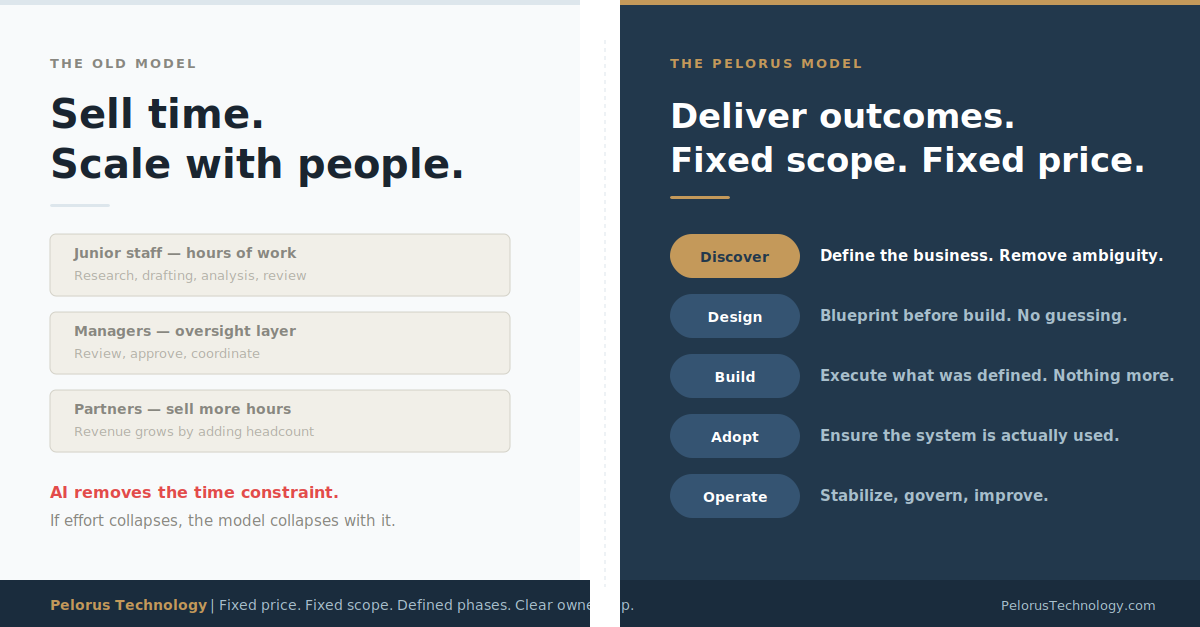
AI Is Breaking the Professional Services Model. We Rebuilt Ours Before It Happened.
Woman contemplating
November 6, 2025
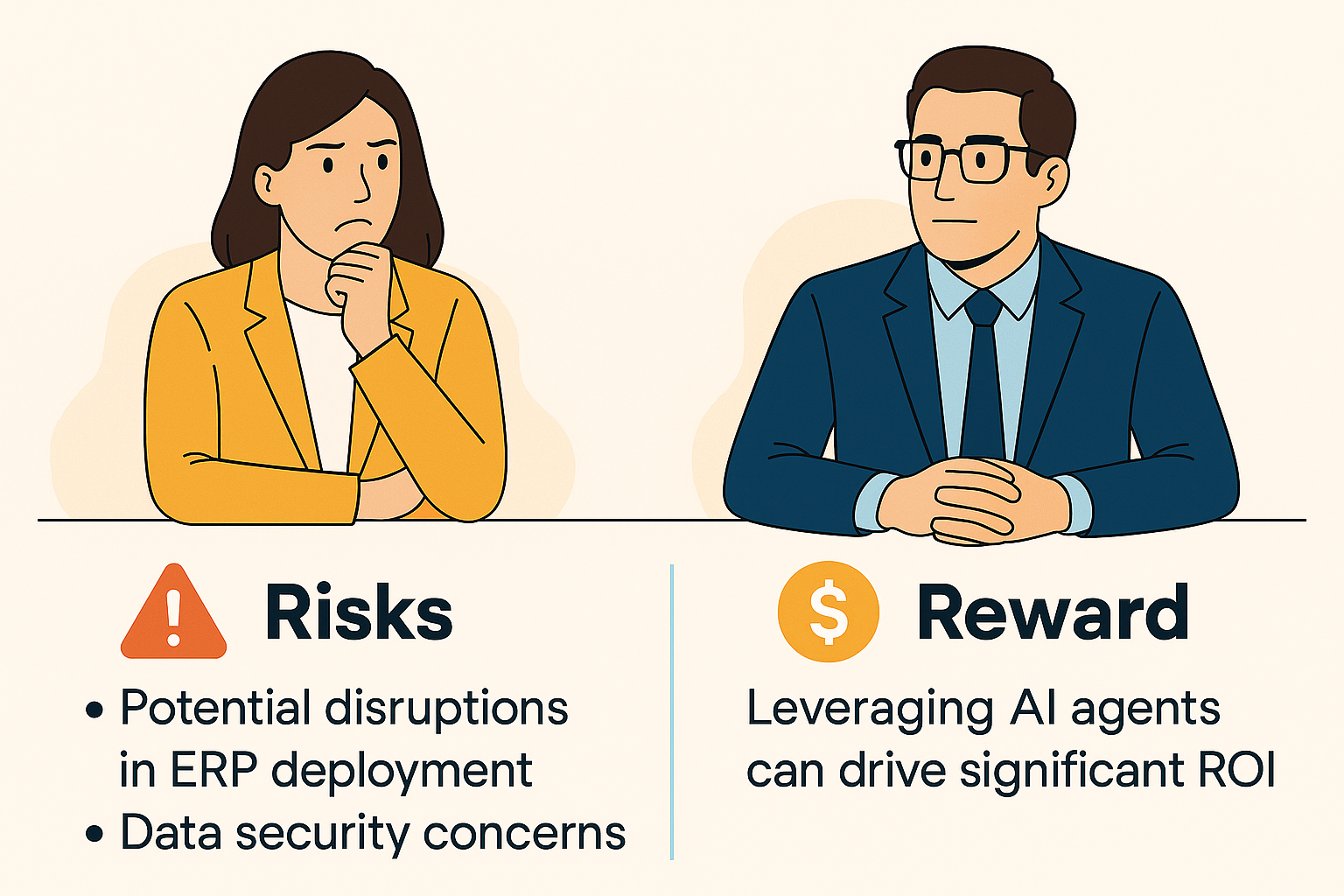
Quarterly updates to Microsoft Dynamics 365 Finance & Supply Chain Management (FSCM) are both a blessing and a burden. On one hand, they deliver innovation, security, and compliance. On the other, they introduce operational risk, testing overhead, and change fatigue. The key to turning these updates into a competitive advantage lies in reframing them not as disruptions to endure, but as opportunities to adopt the new AI Agents Microsoft is rolling out across 2025. At Pelorus Technology , we help organizations navigate this balance through our Strategic Risk Assessment and Alignment Launchpad . This structured service uses modern AI analysis tools to map your actual usage patterns against the risks and rewards of each quarterly release. 

Business team reviewing data charts around a table, discussing, with coffee.
By Craig Johnston September 12, 2025
Artificial Intelligence is no longer a buzzword—it’s a business imperative. In the world of ERP and CRM, AI is transforming how companies operate, engage customers, and drive profitability. Microsoft has embedded AI deeply into Dynamics 365, offering both Generative AI tools like Copilot and Agentic AI solutions that automate entire workflows. In this post, we’ll explore: How Copilot helps users find data faster and respond to queries with precision Why Agentic AI agents are revolutionizing operations across sales, service, finance, and supply chain Real-world examples of companies achieving measurable ROI How Pelorus Technology’s Strategic AI Alignment Service helps businesses deploy AI with purpose
Four office workers looking stressed in front of laptops; text says
September 4, 2025
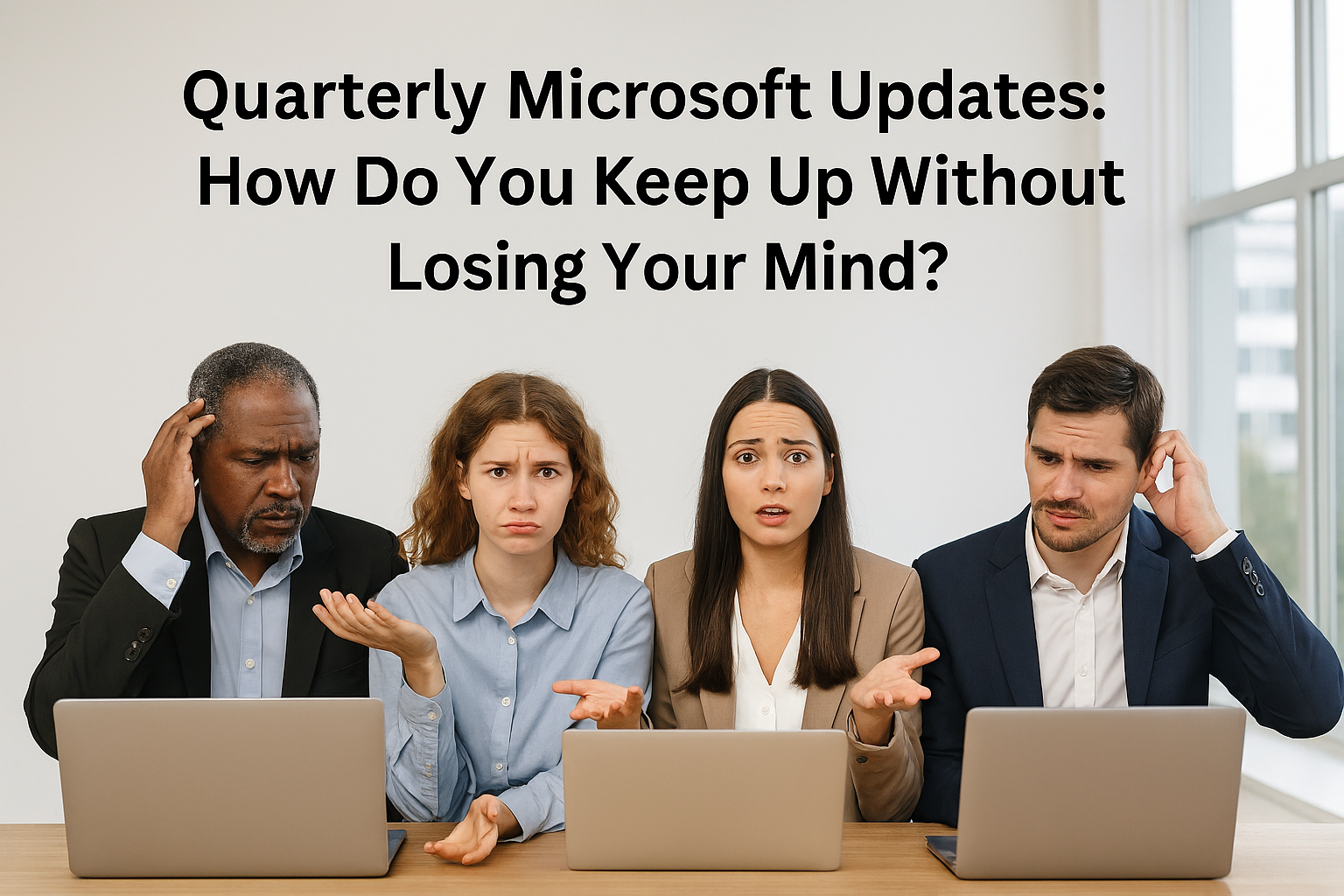
Every quarter, Microsoft releases a flood of updates for Dynamics 365 ERP and CRM systems. These updates promise innovation, security, and compliance—but for many organizations, they also bring confusion, disruption, and stress. If you’ve ever stared at a release wave document wondering, “Which of these features matter to us? Which ones are mandatory? How do we train our teams before everything changes?” —you’re not alone. In this post, we’ll break down: How Microsoft schedules and releases updates Which features are mandatory vs. optional Why ignoring updates is risky Best practices for managing updates without losing your mind How Pelorus Technology’s Strategic Update Alignment Service turns this challenge into a competitive advantage 

Team collaborating in a modern office, discussing ERP security risks and strategies.
August 12, 2025
Discover the hidden ERP security risks of on-premise systems and learn how Microsoft Dynamics 365 Business Central strengthens protection, compliance, and resilience.

July 21, 2025
Legacy systems weren’t built for modern growth. This post explores how Cloud ERP with Business Central gives SMBs the flexibility, visibility, and scalability they need—without the cost and complexity of outdated tools.

Warehouse workers using a tablet after Business Central migration.
June 25, 2025
Planning a Business Central migration? Learn key steps, avoid common pitfalls, and get real-world guidance to ensure your ERP project stays on track.
By Emma Wright June 12, 2025
When organisations are looking at a new ERP solution, Dynamics 365 Business Central (BC), is often evaluated alongside Microsoft’s other ERP offering, Dynamics 365 Finance and Supply Chain Management (F&SCM), with various decision factors coming into play. Selecting the right ERP solution is critical for meeting your future business needs. Unfortunately, Business Central is sometimes unfairly overlooked due to misconceptions that it lacks the advanced capabilities of its Microsoft counterpart. In the article below, Emma Wright, Director of Product Management at Seer 365, dispels the top five myths surrounding Business Central. So, whether you’re an organisation weighing up your future ERP solution options, or you work for a Microsoft partner implementing either of Microsoft’s ERP offerings, we would encourage you to read on. Over the years, I have worked with several partners that sell and implement both Microsoft’s Business Central and Finance and Supply Chain Management (F&SCM) ERP solutions. As a Business Central specialist, I have often found myself defending its capabilities when it is compared against its Microsoft brother. Many professionals with a F&SCM background tend to underestimate Business Central. In this article, I will address some of the most common misconceptions and myths about the solution that I have encountered over my 20+ years in the industry.

Two white puzzle pieces are sitting next to each other on a blue surface
May 6, 2025
Need help preparing your fit-gap analysis for Business Central? Talk to our team at Pelorus Technology today. We’ll show you how our approach and GYDE365 guarantee a successful project and give you the clarity, confidence, and momentum you need!